
Key Highlights
Step up your preparation with the IELTS Listening Practice Test. Test your listening skills, then explore the transcript and answer key to understand your results.
In this test, you will listen to 4 Sections and answer Questions 1–40 based on the information you hear. Each section reflects a typical situation you may encounter in the actual IELTS Listening exam.
-
Section 1: Car for Sale
-
Section 2: Touring Information about The Treloar Valley
-
Section 3: A senior student, Howard, gives advice to his junior classmate regarding the dissertation.
-
Section 4: A psychology undergraduate giving a lecture on creative writing
By completing this practice test, you can strengthen your listening skills, understand spoken English more effectively, and prepare yourself confidently for the IELTS exam.
LISTENING PRACTICE TEST 4
Section 1
This audio contains answers to questions 1–10.
Questions 1-10
Complete the notes below.
Write NO MORE THAN ONE WORD OR A NUMBER for each answer.
Car For Sale (Mini) |
|
Example Age of car: just under 13 years old |
|
Colour: 1__________ Mileage: 2__________ Previous owner was a 3__________ Current owner has used the car mainly for 4__________ Price: may accept offers from 5 £______________ (Note: 6__________ not due for 5 months) Condition: good (recently serviced) Will need a new 7_____________ soon Minor problem with a 8_____________Viewing Agreed to view the car on 9___________ a.m. Address: 238 10_________ Road. |
Section 2
This audio contains answers to questions 11–20.
Questions 11-14
Choose the correct letter, A, B or C.
11. The Treloar Valley passenger ferry
A. usually starts services in April.
B. departs at the same time each day.
C. is the main means of transport for local villagers.
12. What does the speaker say about the river cruise?
A. It can be combined with a train journey.
B. It’s unsuitable for people who have walking difficulties.
C. The return journey takes up to four hours.
13. What information is given about train services in the area?
A. Train runs non-stop between Calton and Plymouth.
B. One section of the rail track is raised.
C. Bookings can be made by telephone or the Internet.
14. The ‘Rover’ bus ticket
A. can be used for up to five journeys a day.
B. is valid for weekend travel only.
C. has recently gone down in price.
Questions 15-20
Label the map below. Write the correct letter, A - H, next to questions 15-20.
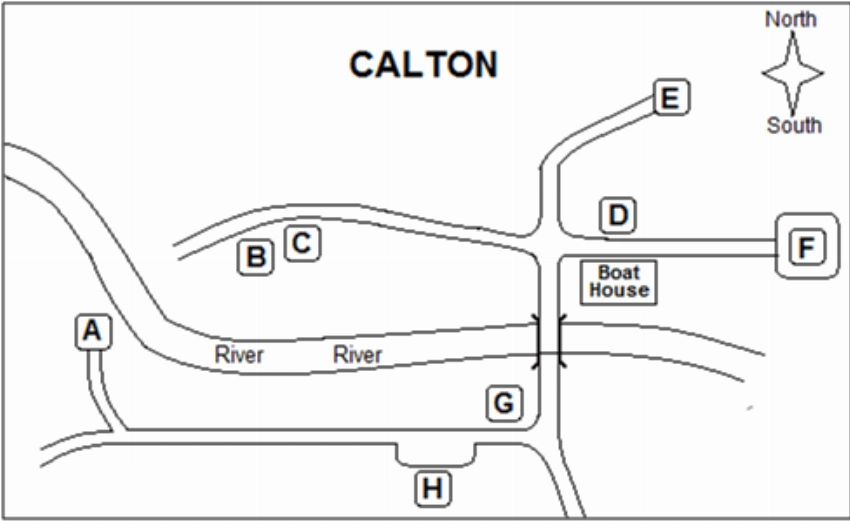
15. Bus stop ____________
16. Car park ____________
17. Museum ____________
18. Mill ____________
19. Potter’s studio ____________
20. Cafe ____________
Section 3
This audio contains answers for questions 21–30.
Questions 21-24
21. What does Howard say about the experience of writing his dissertation?
A. It was difficult in unexpected ways.
B. It was more enjoyable than he’d anticipated.
C. It helped him understand previous coursework.
22. What is Joanne most worried about?
A. Finding enough material.
B. Missing deadlines.
C. Writing too much.
23. What does Howard say was his main worry a year previously?
A. Forgetting what he’d read about.
B. Not understanding what he’d read.
C. Taking such a long time to read each book.
24. What motivated Howard to start writing his dissertation?
A. Talking to his tutor about his problems.
B. Seeing an inspirational TV show.
C. Reading a controversial journal article.
Questions 25-26
Choose TWO letters, A-E.
25 - 26 What TWO things does Howard advise Joanne to do in the first month of tutorials?
A. See her tutor every week.
B. Review all the module booklists.
C. Buy all the key books.
D. Write full references for everything she reads.
E. Write a draft of the first chapter.
Questions 27-28
Choose TWO letters, A-E.
27 - 28 What TWO things does Howard say about library provision?
A. Staff are particularly helpful to undergraduates.
B. Inter-library loans are very reliable.
C. Students can borrow extra books when writing a dissertation.
D. Staff recommend relevant old dissertations.
E. It’s difficult to access electronic resources.
Questions 29-30
Choose TWO letters, A-E.
29 - 30 What TWO things does Joanne agree to discuss with her tutor?
A. The best ways to collaborate with other students.
B. Who to get help from during college vacations.
C. The best way to present the research.
D. Whether she can use web sources.
E. How to manage her study time.
Section 4
This audio contains answers for questions 31–40.
Questions 31-40
Complete the flow chart below.
Write NO MORE THAN TWO WORDS for each answer.
|
Background – researcher had previously studied 31 _____________ |
|
Had an initial idea for research – inspired by a book (the 32________of a famous novelist). |
|
Posed initial question – why do some people become experts whilst others don’t? |
|
Read expert research in different fields. Avoided studies conducted in a 33________ because too controlled. Most helpful studies-research into 34________ e.g. waiting tables. |
|
Found participants: four true 35________ in creative writing (easy to find) and four with extensive experience. |
|
Using ‘think-aloud’ techniques, gathered 36________ data from an inexperienced writer. (During the session, the assistant made 37________ recordings). |
|
Gathered similar data from experienced writers. Compared two data sets and generated a 38________ for analysis |
|
Got an expert 39________ to evaluate the quality of the different products. |
|
Identified the most effective 40________ of stages in producing text |
Answers

Unlock Remaining Answer

