

Key Highlights
- What Exactly Is the O-1 Visa and Who Is It For?
- What are the O-1 Visa Requirements You Must Meet?
- Who Qualifies for an O-1 Visa? Real Profiles That Succeed
- What Are the O-1 Visa USA Requirements for the Application Process?
- What Documents Are Required for the O-1 Visa?
- How Much Does the O-1 Visa Cost for Indian Applicants?
- How Long Does the O-1 Visa Processing Time Take from India?
- What Are the Benefits of the O-1 Visa for Indian Professionals?
- Can the O-1 Visa Lead to a Green Card?
- 2026 Industry Context
- Conclusion
The O1 Visa is a highly regarded work visa granted to individuals with outstanding talent and special qualifications in one or more of the following fields: science, technology, business, education, athletics, arts, film, or television. It provides an opportunity for skilled professionals, researchers, entrepreneurs, artists, and creators from India to secure jobs in the United States without going through the H-1B lottery. Knowing the O1 visa requirements in the USA is critical, as applicants are expected to be recognised at the national or international level and to be supported by a U.S. employer or agent when applying.
What Exactly Is the O-1 Visa and Who Is It For?
The O1 visa is one of the U.S. nonimmigrant visas granted only to those who have achieved a "high level of distinction" in their field due to sustained and Countrywide or International recognition.
-
Temporary Work Authorisation: Allows temporary residents and workers to enter the United States and seek work in a particular skill field. Extraordinary Talent Standard: USCIS Policy Manual requires applicants to have "extraordinary ability" or achievement, which is the rare case of an expert who has been generally recognised for exceptional talent.
-
Two Broad Subcategories: The visa is divided into two broad categories: O-1A is for technical/business categories, and O-1B is for the creative/entertainment categories.
-
USCIS Legal Standard: For O-1A applicants, extraordinary ability is defined as the level of talent and knowledge required for the top tier, meaning you are certainly among the few in your field who have reached the pinnacle. In the case of O-1B (Arts), the legal standard becomes a bit lower: prominence and renown.
|
Feature |
O-1A Subcategory |
O-1B Subcategory |
|
Primary Target |
Professionals in science, business, education, and athletics. |
Creative professionals in the arts, film, television, and streaming. |
|
Legal Benchmark |
Arisen to the very top of the industry. |
Distinction or extraordinary achievement. |
|
Core Requirement |
Sustained national or international acclaim. |
Prominence, renown, or a record of outstanding media success. |
What Is the Difference Between O-1A and O-1B?
O-1A vs O-1B differ in the industries they are meant to cover, the specific evidentiary requirements, and the level of proof immigration officers must rely on. There is a crucial sub-classification difference for the O-1B. Those involved in the motion picture, television or streaming industry are measured by a far greater standard in law, that of "extraordinary achievement", as compared to the standard used for standard visual or performing arts, which is "distinction" (prominence or leadership). They have to show a level of proficiency and awareness far greater than what one typically finds in the entertainment industry.
|
Feature |
O-1A |
O-1B (Arts) |
O-1B (Film/TV) |
|
Fields covered |
Science, education, business, athletics |
Fine arts, performing arts, fashion, and culinary arts |
Motion picture, television, streaming |
|
Evidence standard |
Extraordinary ability |
Distinction |
Extraordinary achievement |
|
Criteria to meet |
At least 3 of 8 |
At least 3 of 6 |
At least 3 of 6 |
|
Common applicants |
STEM researchers, AI engineers, founders, athletes |
Musicians, visual artists, dancers, designers |
Directors, actors, producers |
Pro Tip: Indian IT professionals and STEM researchers should target the O-1A category, where USCIS has recently broadened its interpretation to include high-citation researchers, senior engineers with patent portfolios, and startup founders with documented business impact.
Also Read: How Many Types of Visas are in the USA? New Full Expert Guide
What are the O-1 Visa Requirements You Must Meet?
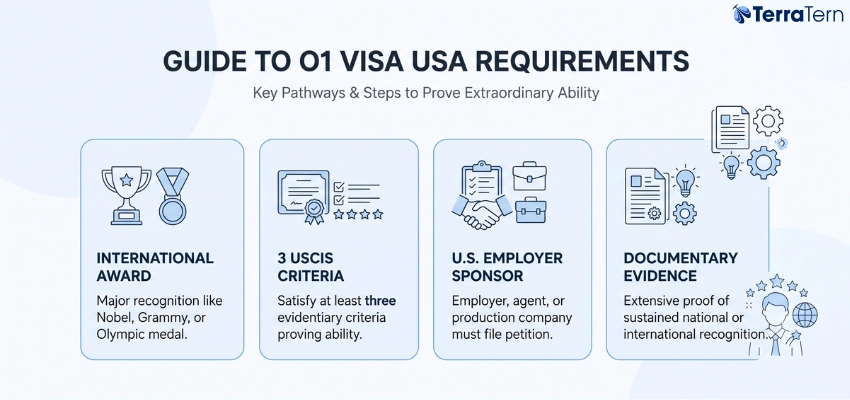
To meet O1 visa USA requirements, an applicant must either hold a major internationally recognised award or satisfy at least three USCIS evidentiary criteria proving extraordinary ability. A U.S. employer, agent, or sponsor must file the petition on the applicant’s behalf, as self-petitioning is not allowed.
-
Meet one of two qualification pathways under a major international award (e.g., Nobel Prize, Grammy, Pulitzer, Olympic medal) or at least 3 USCIS evidentiary criteria.
-
Demonstrate sustained national or international recognition in science, business, education, athletics, arts, or entertainment.
-
Provide extensive documentary evidence supporting achievements, contributions, and professional standing.
-
Secure a U.S. employer, agent, or production company willing to sponsor the petition.
-
Obtain a peer advisory opinion or consultation from the relevant industry organisation, where required.
-
Show that the proposed U.S. work directly relates to the area of extraordinary ability under applicable
What Are the 8 USCIS Criteria for O-1A Eligibility?
Applicants who do not hold a single major international award must generally satisfy at least three of the following O-1 visa requirements for O-1A classification:
-
Major Awards or Prizes: Receipt of nationally or internationally recognised awards for excellence; examples include national innovation awards, startup awards, or prestigious research honours. Strong evidence includes certificates, citations, and official announcements.
-
Exclusive Memberships: Membership in associations that require outstanding achievements, not merely payment of dues. Evidence may include selection criteria and membership approval records.
-
Media Coverage: Published material about the applicant in major newspapers, trade publications, or recognised media. Strong evidence includes articles from prominent Indian or international publications.
-
Judging the Work of Others: Serving as a reviewer, evaluator, competition judge, conference panellist, or grant assessor. Documentation should include invitations, judging records, and certificates.
-
Original Contributions of Major Significance: Demonstrating innovations, patents, research breakthroughs, or business contributions with measurable industry impact. Independent expert letters are especially valuable.
-
Authorship of Scholarly Articles: Publishing research papers, technical articles, or industry publications in respected journals or media outlets. Evidence includes publication records and citation metrics.
-
Critical or Essential Roles: Holding key leadership or specialist positions in distinguished organisations such as multinational companies, research institutions, or leading startups. Employment letters should confirm the applicant's importance.
-
High Salary or Remuneration: Earning significantly more than peers in the field. Supporting evidence includes salary slips, contracts, tax records, and compensation benchmarking reports
Key Note: Indian applicants most commonly qualify through criteria 5 (original contributions strong for AI researchers and engineers with patents or widely-cited work), 6 (scholarly articles ideal for academics), and 7 (critical roles effective for senior engineers and team leads at top-tier tech companies like Google, Microsoft India, or Infosys).
What Are the O-1B Eligibility Criteria for Artists and Entertainers?
The O-1 visa requirements for O-1B applicants differ slightly from those of O-1A. Artists must show "distinction" in their field, while film and television professionals must demonstrate "extraordinary achievement."
-
Lead or Starring Roles: Evidence of leading roles in distinguished productions, performances, films, television projects, or exhibitions.
-
National or International Recognition: Reviews, media coverage, critical acclaim, or professional recognition demonstrating distinction in the arts.
-
Lead, Starring, or Critical Roles for Distinguished Organisations: Work with prominent production houses, orchestras, fashion brands, cultural institutions, or entertainment companies.
-
Commercial or Critical Success: Strong box-office performance, streaming success, ratings, ticket sales, chart rankings, or industry recognition.
-
Significant Recognition from Experts: Testimonials from renowned directors, producers, critics, curators, or industry leaders confirming exceptional achievements.
-
High Compensation: Evidence that earnings are substantially higher than those of others working in similar artistic or entertainment roles.
-
Major Awards or Nominations: Recognition through prestigious awards, nominations, or honours in film, television, music, fashion, theatre, or the arts.
-
Indian Examples: Award-winning Bollywood directors, internationally touring Indian classical musicians, acclaimed fashion designers, and film professionals with global recognition may qualify.
Who Qualifies for an O-1 Visa? Real Profiles That Succeed
Anyone, regardless of nationality, including Indian citizens, can qualify for an O1 visa if they can demonstrate sustained national or international acclaim and satisfy at least three USCIS evidentiary criteria. Eligibility is evidence-based, not title-based.
-
Senior STEM Professionals & Researchers: AI experts, scientists, engineers, and researchers may qualify for an O-1 visa using patents, published research, citation records, industry awards, and peer-reviewed activities.
-
IIT/IIM Alumni in Leadership Roles: Senior managers, product leaders, consultants, and executives can strengthen an O-1 visa case by demonstrating critical roles, media recognition, high salaries, and measurable business impact.
-
Startup Founders & Entrepreneurs: Founders of successful ventures may qualify for an O-1 based on fundraising achievements, revenue growth, innovation awards, patents, investor backing, and press coverage.
-
Award-Winning Artists & Musicians: Performers, directors, writers, designers, and musicians can support an O-1 visa application with major awards, critical reviews, international performances, exhibitions, and media features.
-
Elite Athletes & Coaches: Professional athletes, national champions, and recognised coaches may obtain an O-1 visa based on rankings, medals, championship records, endorsements, and expert testimonials that demonstrate excellence.
Can Indian Nationals Apply for the O-1 Visa?
Yes. Indian nationals can apply for the O-1 visa, and there are no country-specific restrictions
-
Indian citizens are fully eligible if they meet the applicable requirements and secure a U.S. sponsor or agent.
-
Unlike the H-1B visa, the O-1 visa is not subject to an annual lottery, making it attractive to highly accomplished professionals.
-
Many Indian applicants use the O-1 as an alternative when facing uncertainty with H-1B selection or long employment-based immigration timelines.
-
The O-1 is particularly valuable for professionals, researchers, founders, and artists who can document achievements
-
For Indians waiting in lengthy EB-2 and EB-3 green card queues, the O-1 can provide a faster route to work in the U.S. while pursuing long-term immigration options.
As per TerraTern Expert: For Indian professionals who have lost the H-1B lottery multiple times, the O-1 is not just an alternative; it is often a superior pathway. There is no lottery, no cap, no prevailing wage requirement, and no country-based backlog for extensions or green card transitions via EB-1A.
What Are the O-1 Visa USA Requirements for the Application Process?
Secure a U.S. employer or agent sponsor to file the petition on your behalf; you cannot self-petition. Indian applicants typically use the hiring company or an authorised U.S. agent as a sponsor.
-
Obtain: a mandatory advisory opinion/consultation letter from a relevant peer group or labour organisation (this can sometimes be waived); start this early, as some organisations take time to respond.
-
Assemble: the evidence package showing extraordinary ability (awards, publications, high salary, leading roles, expert testimonials, contracts, itinerary) tailored to O-1 visa requirements.
-
Sponsor files Form I-129 (including I-129O/P supplement) with USCIS, no more than 1 year and no less than 45 days before the employment start date; consider Premium Processing to shorten adjudication time.northwestern+1
-
USCIS Adjudication: wait for Form I-797 approval/receipt notice; if approved, the petition is sent to the consulate for overseas applicants.
-
Consular Processing in India: complete the DS-160, pay the visa fees, schedule the interview at the appropriate U.S. Embassy/Consulate, and bring the I-797 and petition documents to the interview.
-
Visa Stamp & Entry: if the visa is approved, collect the passport with the O-1 stamp and enter the U.S. up to 10 days before the start date (a practical check with the airline/CBP is recommended).
What Is an Advisory Opinion Letter and Do You Need One?
An advisory opinion is a written consultation from a relevant peer group or labour organisation that evaluates your qualifications for the O-1; USCIS generally requires it
-
It is meant to confirm that your achievements meet the field’s standards and should be requested early in your case timeline.
-
USCIS can waive the consultation when no appropriate peer group exists or when impractical to obtain.
-
SAG‑AFTRA or Actors’ Equity for film/theatre, industry professional societies or scientific bodies for STEM applicants.
-
Keep the original consultation letter in your petition package; consular officers often expect it at the interview
Which US Embassy in India Handles O-1 Visa Interviews?
U.S. consular posts in India: New Delhi, Mumbai, Chennai, and Hyderabad handle O-1 visa interviews; jurisdiction depends on the applicant’s residential state/union territory.
-
Bring I-797 approval, full copies of the I-129 petition, DS-160 confirmation, passport (valid for 6+ months), photos, and supporting evidence used in the petition.
-
Typical consular questions: job role, employer details, contract/itinerary, evidence of extraordinary ability, and intent to work for the sponsoring employer
-
Expect scheduling waits; the interview may finish or be followed by administrative processing (221(g)), which can add weeks or months.
-
If asked for additional evidence, respond through the consulate’s instructions promptly; use counsel if possible to reduce delays
Important Tip: Indian applicants should schedule their US Embassy interview immediately after receiving USCIS I-797 approval notice. Embassy wait times in Mumbai, New Delhi, and Hyderabad for non-immigrant visas can be 2–8 weeks, and advance scheduling is critical to avoid delays.
What Documents Are Required for the O-1 Visa?
USCIS petition documents (filed by U.S. employer/agent):
-
Form I-129 (Petition for a Nonimmigrant Worker) and required supplements (I-129 package).
-
Written employment contract or a summary of any oral agreement.
-
Detailed itinerary of events/activities in the U.S. (dates, locations, services).
-
Advisory opinion/consultation letter from a relevant peer group or labour organisation.
-
Evidence of extraordinary ability (awards, publications, media coverage, expert recommendation letters, salary evidence, and leading-role documentation).
-
Copies of prior U.S. visa approvals or petitions, if applicable.
-
O1 Visa evidence packages often run 300–700 pages; certify and organise exhibits clearly.
-
If any documents are not in English, provide certified translations (signed and stamped).
Consular Processing Documents (Prepared by the Indian Applicant):
-
Valid Indian passport (valid for at least 6 months beyond the intended U.S. stay).
-
DS-160 confirmation page with barcode.
-
Original I-797 USCIS approval notice (or USCIS approval packet).
-
Visa application fee (MRV) payment receipt and, where applicable, visa integrity fee receipt.
-
Two recent passport-size photographs meeting U.S. visa specs.
-
Supporting subset of the petition evidence showing extraordinary ability (selected letters, awards, publications).
-
Offer letter or contract from the U.S. employer/agent and itinerary.
-
Any additional documents requested by the consulate (proof of ties, prior immigration history).
Expert Advice: Indian applicants whose evidence (awards, press coverage, academic publications) exists in Hindi, Tamil, or other regional languages must provide certified English translations. USCIS does not accept untranslated documents, and this is a common source of avoidable delays.
How Much Does the O-1 Visa Cost for Indian Applicants?
Fee table (USD and approximate INR conversions; 1 USD ≈ 83 INR — round for clarity):
|
Cost Item |
Amount (USD) |
Approx. Amount (INR) |
Notes |
|
Form I-129 filing fee (small employer) |
$530 |
INR 44,000 |
USCIS fee, non-refundable |
|
Form I-129 filing fee (large employer) |
$1,055 |
INR 87,500 |
Employers with 26+ employees |
|
Visa integrity fee (FY2026) |
$250 |
INR 20,750 |
New, non-waivable |
|
DS-160 / Consular (MRV) fee |
~$205 |
INR 17,000 |
Paid to the U.S. Embassy/Consulate |
|
Premium processing (optional) |
$2,805–$2,965 |
INR 233,000–INR 246,000 |
15-business-day service (fee may change) |
|
Advisory opinion letter |
$250–$500 |
INR 20,750–INR 41,500 |
Peer group or union charges (estimate) |
|
Certified translations |
$100–$500 |
INR 8,300–INR 41,500 |
If the documents are not in English |
|
Attorney/legal fees |
$3,000–$8,000 |
INR 249,000–INR 664,000 |
Case-dependent; largest variable |
Expert Tip: The highest and most variable cost is the immigration attorney's fee. For a visa category where petition quality directly drives the ~94% approval rate, working with an experienced attorney is not an optional luxury; it is a strategic investment.
How Long Does the O-1 Visa Processing Time Take from India?
The total O-1 Visa processing time for Indian applicants — from petition preparation to visa stamp — typically ranges from 4 to 6 months with premium processing, or 9 to 14 months with standard processing. This includes USCIS adjudication plus consular processing at a US Embassy in India.
|
Phase |
Standard Timeline |
Premium Processing Timeline |
|
1. Evidence & Petition Preparation |
1 to 3 months |
1 to 3 months |
|
2. USCIS Adjudication |
3 to 9 months |
15 business days |
|
3. Consular Processing (India) |
2 to 8 weeks |
2 to 8 weeks |
|
4. Passport & Visa Issuance |
1 to 3 weeks |
1 to 3 weeks |
|
Total Estimated Time |
9 to 14 months |
4 to 6 months |
What Is O-1 Premium Processing and Is It Worth It for Indians?
O1 Premium Processing is:
-
Expedited Adjudication: O-1 Visa premium processing accelerates the initial USCIS evaluation phase by submitting Form I-907.
Beyond Border -
Government Fees: The optional service requires a mandatory government fee of $2,965, payable in addition to standard base filing fees.
International Student and Scholar Affairs - University of Notre Dame -
15-Day Action Guarantee: USCIS guarantees an initial adjudicative action (approval, denial, Notice of Intent to Deny, or a Request for Evidence) within 15 business days.
Beyond Border -
Indian Applicant Availability: While Indian citizens can utilise premium processing for the initial USCIS petition stage, the expedited timeline does not extend to the Department of State.
-
Consular Interview Limits: Premium processing can only fully expedite a change of status within the US; for consular processing from India, local embassy interview queues and scheduling backlogs cannot be fast-tracked by this fee.
Important Note: If you are applying from India and have a firm employment start date, premium processing for the USCIS I-129 petition is strongly recommended it reduces the most unpredictable stage (USCIS adjudication) from months to 15 business days, even though it cannot accelerate your embassy interview scheduling.
What Are the Benefits of the O-1 Visa for Indian Professionals?
The O1 Visa offers Indian professionals a no-cap, no-lottery alternative to the H-1B, with greater work flexibility, no mandatory wage tiers, and a more direct green card pathway via the EB-1A — where India-specific backlogs do not apply.
|
Feature |
O-1 Visa |
H-1B Visa |
|
Annual Cap |
None |
65,000 (plus 20,000 for US Master’s) |
|
Selection Method |
None (Merit-based adjudication) |
Yes (Highly competitive annual lottery) |
|
Prevailing Wage |
Not required |
Mandatory DOL wage tiers |
|
PERM Labour Cert. |
Not required |
Required for corporate Green Card sponsorship |
|
Filing Flexibility |
Multi-employer flexibility via a US Agent |
Strictly tied to a single petitioning employer |
|
Spouse Employment |
No work authorisation allowed for O-3 status |
Yes (H-4 EAD eligible once I-140 is approved) |
|
Green Card Path |
Direct line to EB-1A (No India-specific backlog) |
Tied to EB-2/EB-3 (Decades-long India backlog) |
|
Extension Limits |
Unlimited 1-year extensions |
Generally capped at 6 years max |
Pro Tip: The single most compelling advantage of the O-1 for Indians is the EB-1A green card transition, where all priority dates are currently current for Indian nationals, potentially cutting decades off the permanent residency timeline compared to the EB-2/EB-3 route.
Can the O-1 Visa Lead to a Green Card?
The transition from an O-1 Visa to a U.S. green card is a highly utilised strategy for top-tier professionals. While the O-1 is technically classified as a non-immigrant visa, USCIS and Department of State policy manuals explicitly state that filing an immigrant petition does not constitute grounds for denying an O-1 visa or its extension.
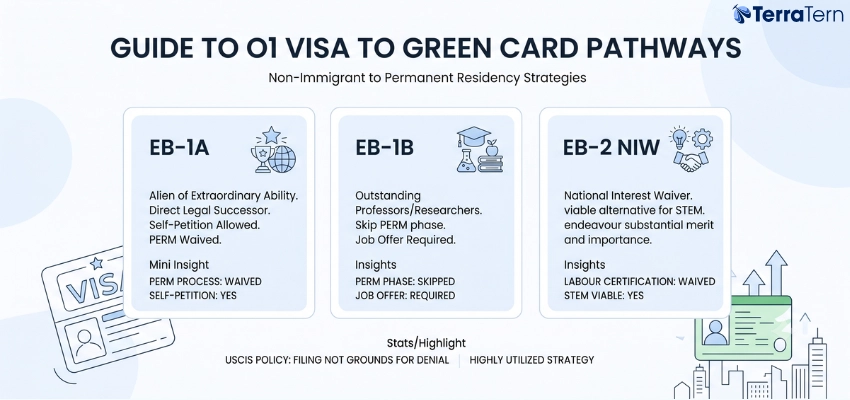
The primary pathways from the O-1 Visa to permanent residency include:
-
EB-1A (Alien of Extraordinary Ability): This is the most direct legal successor to the O-1A visa. It allows self-petitioning (no employer sponsor required), bypasses the lengthy PERM labour certification process, and is generally exempt from the massive visa availability backlogs that impact Indian applicants in other tiers.
-
EB-1B (Outstanding Professors and Researchers): Tailored for academic O-1 holders, this track requires a permanent job offer from a qualifying university or private research institution but skips the PERM phase entirely.
-
EB-2 NIW (National Interest Waiver): A highly viable alternative for STEM and technical professionals. It waives the labour certification requirement if your endeavour holds substantial merit and national importance to the United States.
Key Note: Indian O-1 holders with a strong US track record of 2–3 years should consult an immigration attorney about filing an EB-1A petition concurrently with an O-1 extension. This can compress the total path to a green card for eligible professionals to 3–5 years, compared with 50+ years in the EB-2/EB-3 queue in India.
2026 Industry Context
Current Facts & Statistics:
-
94% Approval Rate: USCIS FY2026 data shows O-1 petitions have maintained a ~94% approval rate since 2022 (Source: USCIS)
-
No Cap, No Lottery. Unlike the H-1B, which has an annual cap of 65,000 and is subject to a lottery, the O-1 has no numerical limit
-
New Fee in Effect: A $250 non-waivable "visa integrity fee" became applicable for O-1 applicants beginning FY2026
-
STEM Surge: USCIS updated its O-1A policy guidance specifically to accommodate STEM professionals, broadening interpretations for engineers, AI researchers, and data scientists
-
Premium Processing Pace: As of October 2026, 80% of O-1 cases are completed within 7 months under standard processing; premium processing guarantees action within 15 business days
-
India Advantage: Unlike EB-2 and EB-3 green cards, where Indian nationals face decades-long backlogs, the O-1 has no country-specific quotas
-
Green Card Bridge: O-1 holders can transition to the EB-1A green card, where all priority dates are currently current for Indian nationals
Conclusion
The O1 visa serves as a powerful, merit-based alternative to the capped H-1B lottery. Backed by a consistent 94% USCIS approval rate, it offers an expedited pathway for extraordinary talent, including a surge of STEM and AI professionals. For Indian nationals looking to bypass decades-long EB-2 and EB-3 queues, the O-1 visa functions as a strategic bridge to permanent residency via the much faster EB-1A green card category.
Contact TerraTern for more information on O1 Visa: Requirements, Eligibility & How Indians Can Apply (2026).




 AI Summary