Key Highlights
- What Is a Germany Business Visa and Who Needs One from India?
- What Are the Two Types of Germany Business Visas for Indians?
- What Is the Complete Germany Business Visa Checklist for Indians?
- How to Write a Strong Invitation Letter for a Germany Business Visa?
- What Is the Germany Business Visa Processing Time for Indians?
- What Is the Germany Business Visa Fee from India in 2026?
- How to Apply for a Business Visa for Germany from India - Step by Step?
- What Are the Germany Business Visa Photo Specifications?
- What Are the Most Common Reasons for Germany Business Visa Rejection from India?
- What Is the 90/180-Day Rule and How Does It Affect Your Germany Business Visa?
- Which German Embassies and VFS Centres in India Handle Business Visa Applications?
- How Can TerraTern Help You Get Your Germany Business Visa Approved?
- Conclusion
Germany business visa can be issued to Indian professionals and entrepreneurs for a short term, typically for up to 90 days within an 180-day period, for purposes of attending meetings, trade fairs and conferences, negotiations, or exploring partnerships. A business visas for Germany from India is a Schengen short‑stay visa, which does not constitute a work permit, and one must have confirmed travel arrangements, financial documentation, travel insurance and business intent and ties to India.
What Is a Germany Business Visa and Who Needs One from India?
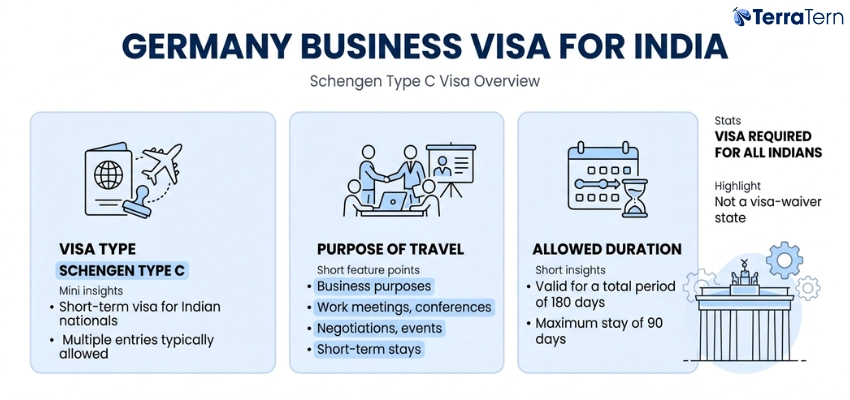
A Germany business visa is the name given to a Schengen Type C short-term visa granted to Indian nationals to visit Germany for business purposes, such as work, meetings, conferences, negotiations, and other short-term stays for a period of 180 days, with a maximum stay of 90 days. Since India is not on the list of visa‑waiver states, all Indians will require this visa.
-
It is often given on a Schengen type C visa, and the stay is short-term (up to 90 days).
-
A National Visa (Type D) is not the same as the one described here, and is for longer visas, of more than 90 days.
-
Indians need a business visa as they are non‑EU and from a non‑waiver country.
-
There are no restrictions on business activities, but regular employment or taking a job is not permitted.
|
Germany Business Visa – Activities |
Allowed |
Not Allowed |
|
Meetings, conferences |
Attending meetings & conferences |
Taking up paid employment |
|
Trade fairs |
Trade fair visits/participation |
Long‑term business setup in Germany |
|
Contracts & deals |
Negotiations and signing contracts |
Providing on‑site services as a worker |
|
Training & workshops |
Short trainings & workshops |
Applying for a residence/work permit |
|
Client/supplier visits |
Visiting suppliers and clients |
Running daily operations as an employee |
|
Work status |
Remote work for a non‑German employer |
Being on a German company’s payroll |
As per TerraTern Expert, Shreya, the Germany Business Visa is not a work permit; using it to provide paid services or work for a German employer is a visa violation that can result in a ban. Always clarify your activities with TerraTern before applying.
Also Read: Germany Business Visa: Checklist, Photo Rules, Time & More
What Are the Two Types of Germany Business Visas for Indians?
The two main germany business visa for Indians include two different visas. India has two main options, each involving a separate visa.
-
The Short-Stay Visa (Type C) is for a stay of up to 90 days within a 180-day Schengen period.
-
National Visa (Type D) is for business subjects who wish to stay for more than 90 days, including for business set-up and/or operation.
-
The business visa type C is the most common visa for Indian citizens travelling to the Schengen countries for business visits or trade fairs.
-
There is no possibility of changing a Schengen business visa into a work visa in Germany.
-
Unlike a tourist visa(no Tourism focus) and a work visa (no work rights).
-
Activities that can and cannot be done.Activities that are allowed and those that are not.
|
Feature |
Schengen Visa (Type C) |
National Visa (Type D) |
|
Stay Duration |
Up to 90 days in any 180‑day period |
More than 90 days |
|
Geographic Scope |
All Schengen countries |
Mainly Germany |
|
Typical Validity |
About 6 months (often with single/multi‑entry) |
Often 1 year or more, depending on the case |
|
Application Location |
Usually via VFS centres in India |
German Embassy/Consulate directly |
|
Fee |
Around €80 |
Varies by category and purpose |
|
Processing Time |
About 10–15 working days |
Several weeks to a few months |
|
Ideal For |
Trade fairs, short meetings, brief visits |
Setting up operations, long negotiations, and repeats |
|
Work Conversion |
Cannot convert to a work visa inside Germany |
May lead to a residence/work permit, if eligible |
Important Note: If you're visiting Germany for Hannover Messe or Bauma and returning within 90 days, a Schengen Type C business visa is your standard route. For plans to open a German branch or stay for more than 3 months, apply for a National Visa (Type D) well in advance, as processing is significantly longer.
What Is the Complete Germany Business Visa Checklist for Indians?
This germany business visa checklist pack is a set of all documents required to be brought to the visa appointment and uploaded/attached to the application along with the visa application. The typical application package contains a valid passport, completed VIDEX application form, biometric photos, evidence of having travel insurance coverage valued at a minimum of €30,000 (valid across Schengen countries), travel program evidence, evidence of freely disposable funds, and solid business and work evidence from India and the Germany host country.
What Documents Does an Employed Indian Applicant Need?
Applicants seeking a Germany Business Visa checklist need to submit all necessary documents as given in the checklist, such as a certificate of stable salaried employment from India, along with approval for leave, etc.
-
Valid passport with at least 2 blank pages for the visas (6+ months past the expiry date)
-
Passports already issued (if available)
-
Paid the visa fees for the VIDEX Schengen visa application
-
2 recent identical photographic ID images (35 mm × 45 mm on a light/white background)
-
Travel insurance with a minimum sum of medical coverage of 30,000 EUROS covering all Schengen countries
-
Confirmation breakdown (reservation – not paid ticket)
-
Proof of your hotel booking or any other confirmation of a confirmed place of stay.
-
One to two pages of personal bank statements in the previous 6 months.One to two pages from personal bank statements for the past 6 months.
-
Employer's letter/acceptance from the NOC to have the FMLA designation
-
Last 3 months’ salary slips
-
Terms and conditions of contract/letter of appointment
-
A letter invitation from a German company for the business (on the letterhead, on the name of the company, the purpose, dates, etc.)
-
Personal cover letter describing purpose, dates and day-by-day itineraries
-
Proof of Indian family (family papers, property, still working, return ticket)
Expert Tip: Your bank statements must show a consistent balance, not just a one-time deposit before the application. German embassies specifically check for sudden large deposits, which can raise red flags.
What Extra Documents Does a Self-Employed Indian Need for a Germany Business Visa?
Business documents and tax documents are a crucial part of the germany business visa checklist for those who are self‑employed and require supporting documents to demonstrate ongoing business activity in India.
-
Registration Certificate of the Company (LLP/Pvt Ltd/Proprietorship Proof, etc)
-
RS-355754 or other relevant tax registration certificate.
-
MOA/AOA or partnership deed (if any)
-
Income Tax Returns (business-relevant ITR forms) of the business for the last 2-3 years
-
CA Certified Financial Statements/ balance sheets and P&L audited
-
Bank statements showing your bank accounts for the past 6 months (front page only)
-
Active business (list of customers, key contracts, invoices, website, brochures, etc.)
-
Member of chamber of commerce/industry association (useful but not required)
Expert Advice: Self-employed applicants often face higher scrutiny on financial documents. A strong 6-month bank statement showing regular business inflows (not just outflows) is your single most important document.
How to Write a Strong Invitation Letter for a Germany Business Visa?
Image:pexels.com/photo/high-rise-buildings-in-a-city-in-frankfurt-germany-10786462/
A strong business visa invitation letter should be on the German company’s official letterhead and can positively influence germany business visa processing time by proving a genuine business purpose.
-
It must include the applicant’s full name, date of birth, passport number, nationality, and a clear purpose and duration of visit.
-
The letter should state who is financially responsible (the host or the applicant) and mention the accommodation arrangements.
-
The host company must add its full contact details and legal registration number (Handelsregisternummer).
-
It has to be signed by an authorised company representative, with their name, designation, and contact details.
-
If you lack a formal invitation, strong alternatives include official trade-fair confirmations, conference registrations, or signed contracts.
-
Avoid vague purposes, mismatched dates, missing passport details, or unsigned letters, as these can cause delays.
Important Tip: A vague invitation letter saying "please come visit our company" is a leading cause of Germany business visa rejection. The letter must be specific about dates, activities, and responsibilities.
Also Read: Germany Business Visa Documents Checklist for Indians
What Is the Germany Business Visa Processing Time for Indians?
The standard germany business visa processing time (Schengen Type C) for Indians is usually about 10–15 working days from the date you submit biometrics at VFS Global.
-
During peak seasons such as trade fairs, Oktoberfest, school holidays, or Christmas–New Year, this can stretch to 30–45 working days, so it is safer to apply earlier.
-
Long‑stay National (Type D) business visas generally take 4–12 weeks, depending on consulate workload and case complexity.
-
Delays often come from incomplete documents, heavy embassy workload, or additional checks for first‑time Schengen travellers.
-
It is recommended to apply at least 3 weeks before travel, and ideally 6–8 weeks in advance to avoid last‑minute issues.
Processing Time Overview
|
Visa Type |
Standard Processing Time |
Peak Season Processing Time |
Recommended Application Lead Time |
|
Schengen (Type C) |
10–15 working days |
30–45 working days |
6–8 weeks before travel |
|
National (Type D) |
4–8 weeks |
8–12 weeks |
3–4 months before travel |
As per our TerraTern Expert: Never book non-refundable flights or accommodation before your visa is approved. Apply as early as possible; German embassies do not expedite standard business visa applications under normal circumstances.
What Is the Germany Business Visa Fee from India in 2026?
For a business visa for Germany from India (Schengen Type C), the consular fee is €80, which usually converts to about INR 7,200–INR 7,500 depending on the exchange rate. VFS will add its own service charge, and you should also budget for travel insurance, photos, and any optional services, such as courier return or agent-assisted document assistance.
|
Cost Component |
Amount (Approx.) |
|
Germany Embassy Visa Fee |
€80 (~INR 7,200–INR 7,500) |
|
VFS Service Fee |
~INR 2,000–INR 2,500 |
|
Travel Insurance |
~INR 1,500–INR 3,000 |
|
Biometric Photo |
~INR 200–INR 500 |
|
Document Translation (if needed) |
~INR 500–INR 1,500 |
|
Courier Service (optional) |
~INR 500 |
|
Estimated Total |
INR 12,000–INR 18,000 |
Pro Tip: The visa application fee is non-refundable regardless of the outcome. Investing in professional document review before submitting is significantly cheaper than re-applying after rejection.
How to Apply for a Business Visa for Germany from India - Step by Step?
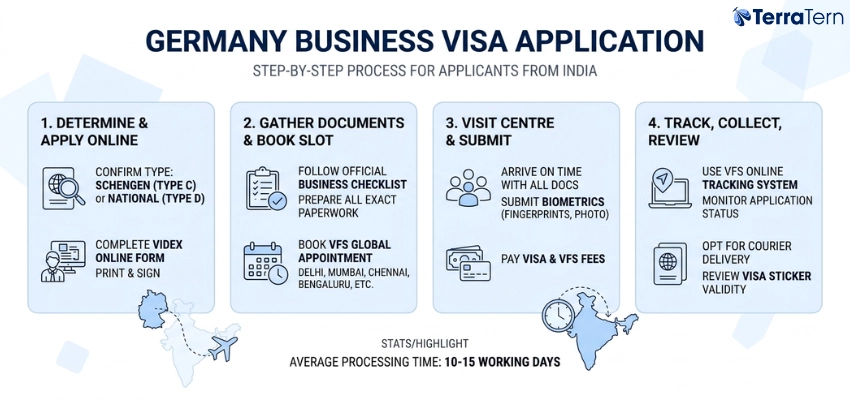
To apply for a business visa for Germany from India: fill the VIDEX online form, gather all required documents, book a VFS Global appointment, submit your application with biometrics, pay the fee, and wait 10–15 working days for a decision.
-
Determine Your Visa Type: Confirm whether you need a Schengen (Type C) or National (Type D) visa based on your stay duration and purpose.
-
Complete the VIDEX Application Form Online: Visit the official VIDEX portal provided by the German government, fill all sections accurately (including personal details, travel purpose, and sponsor details), and print and sign the completed form.
-
Gather All Required Documents: Follow the official business visa checklist for Germany from India, ensuring you have the exact paperwork required for your employment or self-employment status.
-
Book a VFS Global Appointment: Visit the VFS Global India portal, select the nearest application centre (Delhi, Mumbai, Chennai, Bengaluru, Kolkata, or Hyderabad), and book the earliest available slot before peak seasons fill up.
-
Visit the VFS Centre for Biometrics & Submission: Arrive on time with all original documents and photocopies, submit your biometrics (fingerprints and photograph), and pay the visa fee and VFS service charge.
-
Track Your Application: Use VFS Global's online tracking system along with your reference number to monitor the status of your submission.
-
Collect Your Passport: Opt for courier delivery or collect your passport in person at the VFS centre after receiving your approval notification.
-
Review Your Visa Sticker: Carefully check your visa type (C), number of entries (single, double, or multiple), validity dates, and permitted duration of stay before travelling.
Key Note: Book your VFS appointment before finalising your travel itinerary. Appointment slots in major cities like Mumbai and Delhi can be scarce during peak seasons and are often booked 3–4 weeks out
Also Read: .Germany Immigration - Know All The Basics Of It Right Now
What Are the Germany Business Visa Photo Specifications?
The official Germany business visa photo specification requires a size of 35mm × 45mm, with the face occupying 70–80% of the frame (face height: 32–36mm). The background must be light grey or white with no shadows. Photos must be taken within the last 6 months, printed at 400–600 DPI, and show a neutral expression with the mouth closed and eyes open.
What Are the Official Size and Technical Requirements for the Germany Visa Photo?
Meeting the exact Germany business visa photo specification is mandatory for your application. Provide this precise technical criteria to your photographer to ensure compliance:
|
Specification |
Requirement |
|
Photo Size |
35mm × 45mm (3.5cm × 4.5cm) |
|
Face Height |
32–36mm (chin to crown) |
|
Face Coverage |
70–80% of the total image |
|
Face Width |
16–20mm (ear to ear) |
|
Background |
Light grey or white; uniform, no shadows |
|
Expression |
Neutral; mouth closed, eyes open and looking at the camera |
|
Recency |
Taken within the last 6 months |
|
Print Resolution |
Minimum 400 DPI (600 DPI recommended) |
|
Digital Format |
JPEG/JPG; max 120 KB for online submission |
|
Number Required |
2 identical prints |
|
Colour |
Full colour photograph only |
|
Glasses |
Permitted only if lenses are clear, no glare; tinted glasses not allowed |
|
Head Coverings |
Not permitted except for religious reasons |
|
Attire |
Professional/formal clothing recommended |
As per TerraTern Expert, Divyansh, for a business visa specifically, wear formal professional attire (suit, blazer, or collared shirt). While not mandatory, it aligns your photo with the application's professional nature and presents well to consular officers.
What Are Common Photo Mistakes That Lead to Germany Visa Rejection?
Failing to follow the correct Germany business visa photo specification is a frequent cause for application delays or rejections. Avoid these common errors:
-
Incorrect dimensions: The photo is smaller or larger than the required 35mm × 45mm.
-
Improper background: Using a coloured or patterned background instead of neutral light grey or white.
-
Old photograph: Submitting a photo taken more than 6 months before the application date.
-
Shadows: Shadows on the face or in the background caused by poor studio lighting.
-
Glasses issues: Wearing tinted lenses or sunglasses (clear prescription glasses without glare are permitted).
-
Wrong expression: Smiling or opening the mouth instead of the required neutral expression.
-
Head posture: Head tilted or angled instead of facing directly forward.
-
Low quality: Low DPI prints result in blurry or pixelated photos.
-
Improper attire: Wearing casual wear, branded t-shirts, or sports clothing instead of professional attire.
-
File size: Digital photos exceeding the 120 KB limit for online submissions.
Important Note: Get your photos taken at a reputable studio that specifically offers Schengen visa photos, not passport-sized photos, which may differ in dimensions. Always verify specs before your VFS appointment.
What Are the Most Common Reasons for Germany Business Visa Rejection from India?
Germany business visa rejections most commonly occur due to insufficient financial proof, a weak or vague invitation letter, incomplete documentation, inability to demonstrate strong ties to India, or unclear travel purpose
-
Insufficient Financial Proof: Consular officers look for a steady bank balance meeting the minimum €45/day requirement. The Fix: Avoid sudden, massive lump-sum deposits right before applying, as this raises red flags. Provide 3–6 months of consistent bank statements.
-
Weak or Vague Invitation Letter: If the host company's letter lacks specific details, the visa will likely be denied. The Fix: Ensure the invitation explicitly states the exact travel dates, the corporate registration number (Handelsregisterauszug), and the host's complete contact details.
-
Incomplete Document Checklist: Missing even a single mandatory document often results in an outright rejection. The Fix: Treat the official checklist as absolute law; double-check that every required original and photocopy is accounted for before submission.
-
Unclear Purpose of Visit: If your cover letter fails to outline your day-to-day business agenda, the visa team may doubt your intentions. The Fix: Write a transparent, chronological breakdown of your planned meetings, conferences, or training sessions.
-
No Demonstrated Ties to India: A primary concern for visa officers is ensuring you will return home. The Fix: Provide strong evidence of your roots in India, such as property deeds, active employment contracts, or family ties.
-
Travel Insurance Issues: Submitting a policy with coverage below €30,000 or one that doesn't cover the entire Schengen area will lead to instant rejection. The Fix: Buy certified Schengen travel insurance that includes medical repatriation and explicitly spans your whole trip.
-
Previous Visa Violations: Overstaying a prior Schengen visa or violating immigration rules is a major red flag. The Fix: Address any past issues transparently in your cover letter and show strict compliance with current regulations.
-
Incorrect or Non-Compliant Photos: Standard passport photos that fail to meet the strict biometric requirements will be rejected. The Fix: Visit a professional studio and strictly request the exact 35mm × 45mm German biometric specifications.
Expert Advice: The single most common reason for rejection for Indian applicants is financial documentation, specifically bank statements that don't reflect a consistent financial history. Start building your documented financial trail at least 3–6 months before applying.
What Is the 90/180-Day Rule and How Does It Affect Your Germany Business Visa?
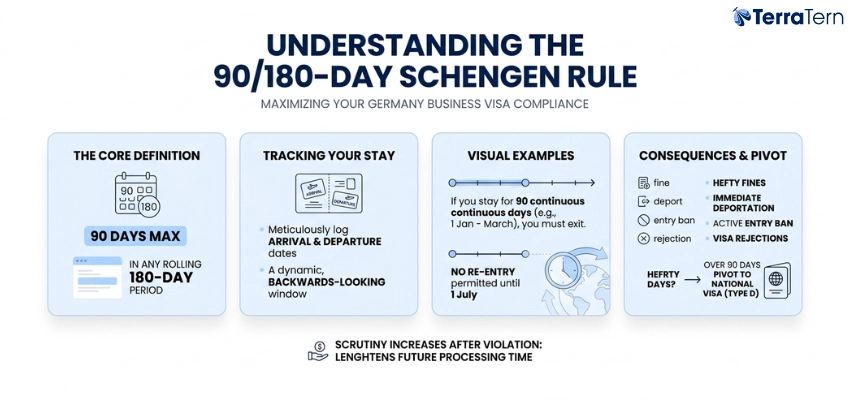
The 90/180-day Schengen rule means you can stay in the entire Schengen Area for up to 90 days within any rolling 180-day period.
-
Understanding the Rolling Window: The 180-day block is a dynamic, backwards-looking window, not a fixed calendar year.
-
A Worked Example: If you enter the Schengen zone on 1 January and stay for 90 continuous days, you must exit by late March. You will not be permitted to re-enter any Schengen country until 1 July.
-
Tracking Multi-Entry Visas: If you hold a multiple-entry business visa, you must meticulously log every single arrival and departure date. It is remarkably easy to lose track during frequent, short corporate trips.
-
Utilising Free Online Tools: To safeguard your travel history, use the official European Commission's free online Schengen calculator to verify your remaining days before booking flights.
-
Consequences of Overstaying: Violating this rule triggers severe penalties, including hefty fines, immediate deportation, an active entry ban, and automatic visa rejections for future applications.
-
Impact on Future Processing: Dealing with an immigration violation adds immense scrutiny to your profile, permanently lengthening your future germany business visa processing time due to manual background reviews.
-
When to Pivot to a National Visa (Type D): If your business operations require you to reside or work in Germany for more than 90 consecutive days, a standard Schengen visa is no longer sufficient; you must apply for a German National Visa instead.
Pro Tip: If you travel to Germany for trade fairs or quarterly reviews more than twice a year, carefully calculate your Schengen days. Frequent business travellers should consider applying for a multi-year multiple-entry Schengen visa or a National Visa (Type D).
Also Read: Germany Visa Types: Experts' Complete Guide for Indians
Which German Embassies and VFS Centres in India Handle Business Visa Applications?
Indians apply for the business visa through VFS Global application centres. Applications must be submitted at the VFS centre in your jurisdiction (based on your state of residence). Submitting to an incorrect jurisdiction will cause your application to be rerouted or rejected, significantly extending your total germany business visa processing time.
|
City |
States Served |
VFS Centre |
|
New Delhi |
Delhi, Uttar Pradesh, Punjab, Haryana, Rajasthan, Himachal Pradesh, Jammu & Kashmir, Uttarakhand, Bihar, Jharkhand |
Multiple Delhi / NCR Centres |
|
Mumbai |
Maharashtra, Goa, Gujarat, Madhya Pradesh, Chhattisgarh |
Mumbai VFS |
|
Chennai |
Tamil Nadu, Kerala, Andhra Pradesh, Telangana, Puducherry |
Chennai VFS |
|
Bengaluru |
Karnataka |
Bengaluru VFS |
|
Kolkata |
West Bengal, Odisha, Northeast India (Assam, Meghalaya, etc.) |
Kolkata VFS |
Key Note: Apply through the VFS centre in the state where you currently reside, not necessarily in the state where your company is registered. Applying at the wrong jurisdiction can lead to document rejection.
How Can TerraTern Help You Get Your Germany Business Visa Approved?
TerraTern's Germany visa experts provide end-to-end support, including document review, VIDEX form guidance, appointment booking assistance, invitation letter review, and application tracking, significantly reducing the risk of rejection for Indian business travellers.
-
Bespoke Document Review: We cross-reference your paperwork against a rigorous, up-to-date germany business visa checklist tailored specifically to your corporate profile, ensuring no document is missed.
-
Flawless VIDEX Form Guidance: Our specialists assist you in navigating the government's official online portal to prevent minor data entry errors that can lead to immediate rejections.
-
Strategic Appointment Booking Support: We help you locate and secure the earliest available appointment slots at your designated VFS Global jurisdiction, saving you valuable time.
-
Invitation Letter Verification: We thoroughly review the invitation letter sent by your German host to confirm it includes all mandatory legal and corporate details required by the consulate.
-
Real-Time Application Tracking: Rest easy while our team monitors your visa's progress through the pipeline, keeping you informed from submission to passport collection.
Important Tip: First-time applicants who use professional visa assistance have a measurably higher approval rate. The investment in expert document review is worth it when your business trip is on the line.
Conclusion
Securing a Germany business visa from India requires meticulous preparation, strict adherence to biometric photo specifications, and a precise understanding of the 90/180-day rule. By avoiding common pitfalls such as vague invitation letters or poor financial proof, you ensure a smooth application process. Let experts like TerraTern streamline your paperwork and manage your VFS jurisdiction, turning a complex administrative process into a highly successful, completely stress-free corporate trip to Europe.
Contact TerraTern for more information on the Germany Business Visa: Expert Guide & Latest Updates for 2026.




 AI Summary