


Key Highlights
- What Is the EB1 Visa, and Why Does It Matter for Indian Applicants?
- What Are the EB1 India Eligibility Requirements?
- What Is the Current EB1 India Priority Date and Visa Bulletin Status?
- Why Is EB1 India Backlogged, and Will It Retrogress Further?
- How Long Is the EB1 India Wait Compared to EB2 and EB3?
- What Is the Step-by-Step EB1 India Application Process?
- How Much Does the EB1 Visa Cost for Indian Applicants?
- What Documents and Evidence Do You Need for a Strong EB1 India Petition?
- EB1A vs EB2 NIW vs H1B: Which Pathway Fits Indian Professionals in 2026?
- What Common Mistakes Delay or Derail EB1 India Petitions?
- 2026 Industry Context Section
- Conclusion
Strategic planning is crucial for highly skilled professionals in the intricate green card process in 2026. Despite recent setbacks for foreign nationals, in particular from China, the EB1 India category continues to be the fastest avenue for acquiring permanent residency in the United States for Indian-born professionals who possess extraordinary abilities, outstanding academic achievements, or multinational executive experience, outstanding academic achievements or multinational executive experience.
Under the recent Visa Bulletins, with shifting priority-date cutoffs and close USCIS scrutiny, it’s critical to understand exactly how EB1 eligibility and timing apply to your profile.
What Is the EB1 Visa, and Why Does It Matter for Indian Applicants?
EB1 India (also called Employment-Based First Preference) is at the top of USCIS's green card priority system. It can give Indian professionals a vital route for relief from the huge pile of applicants on a per-country basis.
-
Skips Department of Labour certification: No need to wait for the long Department of Labour certification process.
-
Rapid Processing: Provides the quickest possible time frame if it's genuinely out there.
-
Self-Petitioning: Sponsorship is not required for the EB1A subcategory. There are a trio of subcategories for the EB1: EB1A, EB1B, and EB1C, explained below.
What Are the EB1A, EB1B, and EB1C Subcategories?
The first and foremost step to obtaining your EB1 India is to select the appropriate classification. Let's make sure we have a clear distinction between our three types of preference subcategories:
|
Subcategory |
Who It's For |
Employer Sponsorship Required? |
Self-Petition Allowed? |
|
EB1A |
Individuals with extraordinary ability in sciences, arts, education, business, or athletics |
No |
Yes |
|
EB1B |
Outstanding professors and researchers (min. 3 years' experience, international recognition) |
Yes |
No |
|
EB1C |
Multinational managers/executives transferring within the same company to a US entity |
Yes |
No |
As per our TerraTern Expert Divyansh, Most Indian applicants only qualify for one of the three subcategories; identifying the right one early prevents months of wasted petition-building effort.
Also Read: US Visa Bulletin June: EB-1, EB-2 Retrogress for India
What Are the EB1 India Eligibility Requirements?
The EB1 India eligibility requirements are:
-
Receipt of nationally or internationally recognised awards or prizes of excellence.
-
Membership in associations that require outstanding achievements of their members.
-
Published material about you in professional or major media.
-
Having served as a judge of the work of others.
-
Original contributions of major significance in your field.
-
Authorship of scholarly articles.
-
Display of your work at artistic exhibitions or showcases.
-
A leading or critical role for organisations with distinguished reputations.
-
High salary or other significantly high remuneration compared to peers.
-
Commercial success in the performing arts.
Important Note: Quality beats quantity; USCIS officers weigh 3–4 well-documented criteria more favourably than 6–7 thin ones; independent, third-party verifiable evidence is what survives the final merits review.
What Is the Current EB1 India Priority Date and Visa Bulletin Status?
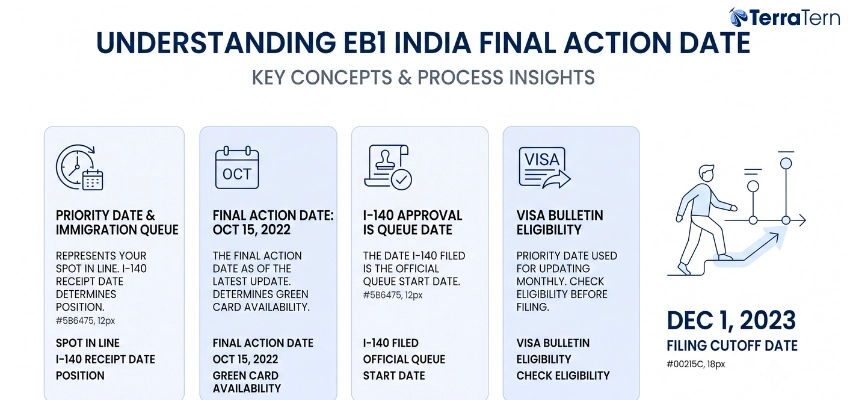
The EB1 India Final Action Date is October 15, 2022 (and the filing cutoff date is December 1, 2023; those who filed with a priority date before October 15, 2022 are in the right direction).
-
The concept of "standing in line" relies on a concept that is determined by your priority date:
-
The priority date for EB1 is generally the date USCIS receives your properly filed Form I-140 petition; this date then controls where you stand in the green-card queue.
-
Since EB1 India does not require a PERM process, no DOL Certification Date.
-
The date you receive your I-140 is your official immigration queue date.
-
This priority date is used for updating monthly to determine eligibility on the visa bulletin.
-
To proceed in the next steps, your date should be before the date specified above.
|
Chart Type |
Cutoff Date (July 2026) |
What It Means |
|
Final Action Date |
October 15, 2022 |
The date a green card can actually be approved and issued. |
|
Dates for Filing |
December 1, 2023 |
The date you can submit your I-485 adjustment of status application. |
Expert Advice: The Visa Bulletin is published monthly and can retrogress with no warning; treat any priority date figure as a snapshot and always confirm against the live bulletin before filing.
Why Is EB1 India Backlogged, and Will It Retrogress Further?
The EB1 India backlog is not the result of increased scrutiny on Indian cases, but because there is a yearly cap on green cards for each country of 7%.
-
Under U.S. law, there is a limit on employment-based visas; annual visas are 7% of the overall quota, and no country can receive more than a limited number of visas, the amount of which is roughly 7% of the overall total.
-
The high influx of highly qualified STEM professionals from India every year makes it hard to keep this number cap consistent over time.
-
Retrogression, where priority date returns are the normal routine of a cyclical system, is not an emergency.
-
The recent trends towards Visa dynamics have had a significant impact on the recent priority date movement, with it also being highly influenced by travel restriction policy and/or consular issues with visas, and these can change as quickly as a flip of a switch.
-
The State Department also issues a warning about the possibility of additional retrogression or availability of visas by quota before the end of FY2026, though the quotas generally reset when the next fiscal year starts in October.
Expert Tip: A backlog reflects demand and law, not case weakness. A well-documented EB1A petition faces the same merits review regardless of country of birth; only the visa-number wait differs.
Also Read: Top Software Engineer Jobs in USA: New Pay, Scope & More
How Long Is the EB1 India Wait Compared to EB2 and EB3?
The EB1 India timeline is meaningfully faster than the EB2 or EB3 categories for Indian nationals. While EB1 applicants are currently processing cases from late 2022, EB2 and EB3 backlogs have regressed dramatically into the early-to-mid 2010s, representing a wait of over a decade for some priority dates.
|
Category |
July 2026 Final Action Date |
|
EB1 India |
October 15, 2022 |
|
EB2 India |
Unavailable |
|
EB3 India |
January 15, 2015 |
-
This massive gap exists because EB1 requires no Department of Labour PERM certification and historically sees lower application volumes relative to its specific visa allocation.
-
Yes, consistently, even during periods of EB1 retrogression, it remains the fastest available path.
-
Some applicants do pivot toward the EB2 National Interest Waiver (NIW) as a related self-petitioning alternative, though it remains bound by the heavily backlogged EB2 timeline.
Important Tip: Don't choose a category based on wait time alone; EB1's shorter queue only helps if your evidence realistically meets its higher merits bar; a strong EB2/EB2-NIW case often beats a weak EB1A case.
What Is the Step-by-Step EB1 India Application Process?
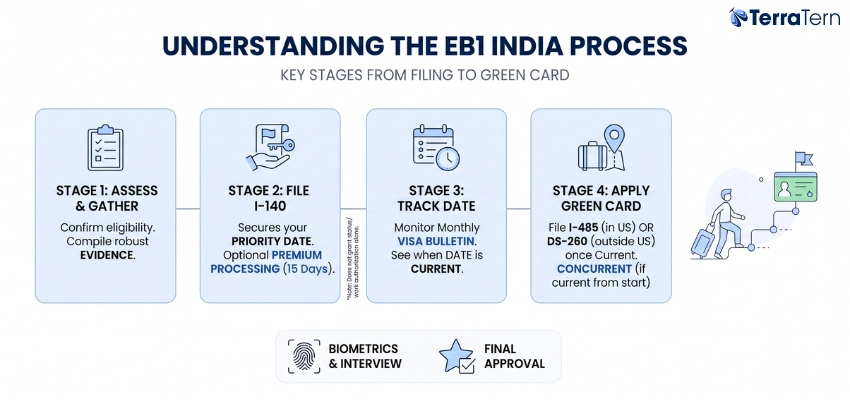
The EB1 India process runs through Form I-140 filing (which sets the priority date), followed by either Form I-485 adjustment of status (if already in the US) or DS-260 consular processing (if applying from India), once the priority date is current.
-
Assess & Gather: Confirm subcategory eligibility and compile robust evidentiary documentation.
-
File Form I-140: Submit your petition to secure a priority date. Crucially, I-140 approval alone does not grant U.S. residency, lawful status, or work authorisation. You can add premium processing to guarantee a 15-business-day adjudication.
-
Track Priority Date: Monitor the monthly Visa Bulletin to see when your specific date becomes current.
-
File I-485 or DS-260: Submit your actual green card application once your date is current. If your date is current at the start, you can file this concurrently with your I-140.
-
Finalise: Attend required biometrics and interviews to receive your final green card approval.
As per our TerraTern Expert: I-140 approval is a milestone, not the finish line; it locks in your priority date and confirms eligibility, but the green card itself depends on your priority date becoming current and completing I-485 or consular processing.
How Much Does the EB1 Visa Cost for Indian Applicants?
Government filing fees for the EB1 India category typically total roughly $700–$1,000+ for Form I-140, plus additional I-485 or DS-260 fees. Optional premium processing adds a separate fee for faster adjudication. Total costs, including legal representation, commonly range from several thousand to over $10,000 depending on case complexity.
-
Legal Fees: Attorney and consultancy fees vary widely based on your profile's complexity; factor this into your budget rather than relying solely on government costs.
-
Currency Fluctuations: When calculating the eb1 visa cost in India, always convert from USD using current exchange rates, as INR approximations quickly go stale.
-
Official Verification: USCIS fee schedules change periodically. You must confirm the exact eb1a fees for 2026 directly on uscis.gov before filing.
Estimated Government Fees (As of July 2026)
|
Fee Component |
Estimated Amount (USD) |
|
Form I-140 (Base Fee) |
~$715 – $1,015 |
|
Premium Processing (Optional) |
$2,805 |
|
Form I-485 (Adjustment of Status) |
~$1,440 (biometrics usually included) |
|
DS-260 (Consular Processing) |
$345 |
Pro Tip: Government filing fees are only part of the budget; factor in translation/certification costs for Indian documents, expert opinion letters, and potential RFE response costs when planning your total spend.
What Documents and Evidence Do You Need for a Strong EB1 India Petition?
A strong EB1 India petition centres on independently verifiable, third-party corroborated evidence mapped directly to USCIS criteria, which is critical for surviving the subjective "final merits determination" stage over self-authored claims.
-
EB1A Evidence: Document your extraordinary ability with objective proof such as major industry awards, national media coverage, patents or original contributions, judging invitations, and data showing a significantly high salary.
-
EB1B Evidence: Outstanding professors and researchers need to present a robust publication record, strong citation counts, and expert recommendation letters affirming their teaching or research impact.
-
EB1C Documents Required: Multinational managers and executives must provide detailed organisational charts, overseas payroll records, and concrete proof of the required qualifying employment abroad to establish the employer relationship.
-
Indian Applicant Challenges: You must navigate specific regional hurdles, such as obtaining certified translations for Indian degree and employment records, standardising financials, and getting recommendation letters from India-based supervisors in the precise format USCIS expects.
Key Note: Independent verification is everything; a recommendation letter from your own manager carries less weight than one from an unaffiliated expert in your field who can speak to your standing objectively.
Also Read: Nursing Jobs in USA: Experts Latest Jobs & Salaries
EB1A vs EB2 NIW vs H1B: Which Pathway Fits Indian Professionals in 2026?
EB1 India fits applicants with standout evidence, like major awards, published impact, or recognised leadership, because it has the highest bar but lets you self-petition.
-
EB2 NIW is better for strong Indian professionals who may not yet qualify for EB1A but can show their work has clear national importance to the U.S. and also want self-petition flexibility.
-
H1B is a temporary employer-sponsored work green card category, and 2026 planning has become harder because a new one-time $100,000 supplemental fee on certain new H-1B petitions introduced in late 2025 has significantly increased the cost of sponsorship for affected employers.
-
Choose EB1A if your evidence is already very strong and you want the fastest independent green card strategy; choose EB2 NIW if your profile is solid but still building toward EB1A strength.
-
For most Indian professionals, the decision comes down to evidence strength, timeline tolerance, and whether employer sponsorship is available or desirable; many are now evaluating self-petitioned options earlier because of H1B uncertainty
Pro Tip: Don't self-petition EB1A on a marginal case just to avoid employer dependency; a well-built EB2 NIW or a sponsored EB2/EB3 case often has a materially higher approval probability than a stretched EB1A filing.
What Common Mistakes Delay or Derail EB1 India Petitions?
EB1 India filings often fail when applicants try to “tick” 10 criteria instead of proving a single, cohesive record of extraordinary ability.
-
Using only Internal Proof: Strong petitions need independent verification; company awards, self-authored letters, or internal recognition alone often trigger an eb1a rfe.
-
Choosing the Wrong Subcategory: Many applicants file EB1A when their profile is better suited to another route, which weakens the overall strategy and delays filing.
-
Ignoring Final Merits Review: Meeting criteria is not enough; officers still assess whether the full record shows sustained national or international acclaim.
-
Confusing I-140 Approval with Green Card Approval: An approved petition is only one step, so assuming the case is finished can lead to missed next steps and timing errors.
-
Waiting for the Visa Bulletin Before Filing. EB1 India applicants sometimes delay unnecessarily, even when their priority date strategy and filing readiness could move sooner.
Key Note: The single most preventable mistake is filing too early with unverified evidence just to "lock in" a priority date; a rejected or heavily RFE'd petition costs more time than a properly built one filed a few weeks later.
2026 Industry Context Section
Latest facts and industry context:
-
Latest Statistic: EB1 India Final Action Date retrogressed from December 15, 2022 (June 2026 Bulletin) to October 15, 2022 (July 2026 Bulletin), a reminder that EB1 India can move backwards as well as forward.
-
Industry Development: The U.S. Department of State has publicly flagged the possibility of further retrogression or the category becoming temporarily unavailable before the fiscal year closes on September 30, 2026.
-
Structural Context: The 7% per-country cap on combined family- and employment-based green cards is the legal root cause of the India/China backlog, not a reflection of case quality or USCIS scrutiny.
-
Legal Development (2026): A federal court ruling out of Nebraska in April 2026 questioned whether USCIS's two-part "Kazarian" evaluation framework for EB1A is being applied lawfully a development worth monitoring for petitioners currently building a case.
-
Policy Ripple Effect: The steep H-1B petition fee increase introduced in late 2025 has measurably increased interest in self-petitioned green card categories, including EB1A and EB2 NIW , among Indian tech professionals looking for an exit from employer-dependent status.
-
Comparative Data Point: Even in a backlogged state, EB1 India's Final Action Date sits years ahead of EB2 India and EB3 India, both of which have retrogressed into the early-to-mid 2010s.
-
Expert Insight (quotable): Immigration analysts note that recent forward movement in some employment-based categories has been driven partly by reduced consular visa issuance under broader US travel restrictions, meaning current pacing may not reflect underlying demand and could reverse.
Important Note: Treat every "current" date in this article as a snapshot, not a guarantee; always cross-check the live Visa Bulletin before making a filing decision.
Conclusion
EB1 India is becoming a central strategy for high-achieving Indian professionals who want a more predictable, self-petitioned route to U.S. permanent residency. By avoiding common EB1A mistakes, building strong independent evidence, and choosing the correct subcategory, applicants can significantly improve their odds. Thoughtful planning early in a career, rather than waiting for H1B or Visa Bulletin changes, helps EB1 India fit into a long-term, resilient immigration plan.
Contact TerraTern for more information on EB1 India 2026: Eligibility, Visa Bulletin & Filing Guide.




 AI Summary